


Presbyopia is the natural, age-related loss of the eye’s ability to focus on nearby objects, making tasks like reading a menu or a text message blurry and difficult.
This condition is an inevitable part of aging that affects nearly everyone, typically becoming noticeable in your early to mid-40s.
In fact, presbyopia impacts an estimated 1.8 billion people globally, making it one of the most common vision impairments in the world.
While the term may sound clinical, the experience is universal: the gradual need to hold your phone or a book at arm’s length to see it clearly.
If you’ve started to notice these changes, you’re not alone. This comprehensive guide will walk you through everything you need to know about presbyopia.
We’ll explore its underlying causes, the progression of symptoms, and the full spectrum of modern treatment options—from simple reading glasses to advanced surgical procedures and newly approved eye drops.
Continue reading to gain a clear understanding of this age-related vision change and discover the best path forward for your eyes.
In This Article
What Exactly Happens to Your Eyes During Presbyopia?
To understand presbyopia, it helps to first understand how your eye’s focusing mechanism, known as accommodation, works. In a young, healthy eye, this process is seamless.
When you look at a distant object, a tiny muscle inside your eye called the ciliary muscle is relaxed.
When you shift your gaze to something up close, this muscle contracts, allowing the eye’s natural lens to become more curved and powerful, bringing the near object into sharp focus.
This entire process is instant and effortless. With age, this remarkable ability begins to decline. The primary culprit is the crystalline lens itself.
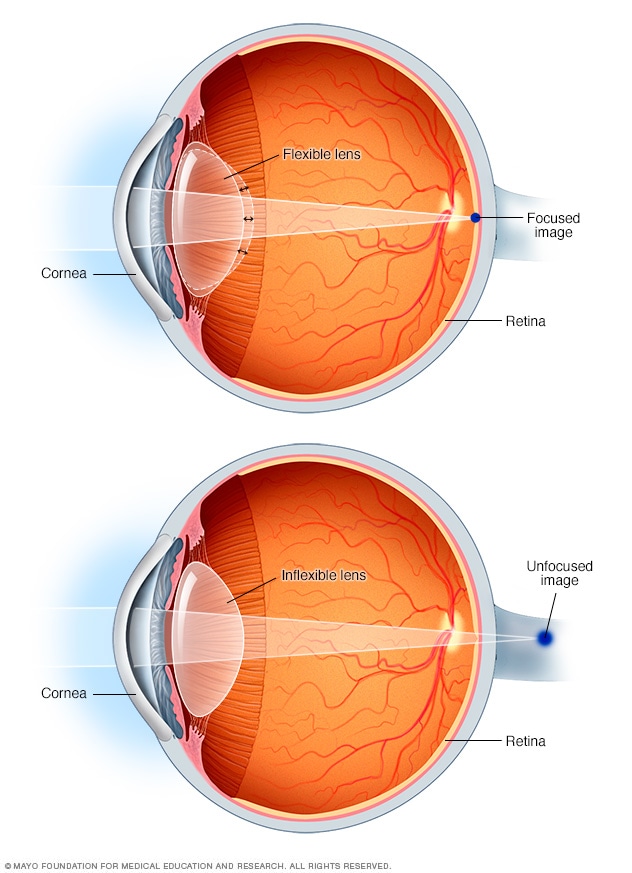
In a normal eye (top), light focuses directly on the retina. With presbyopia (bottom), the hardened lens cannot focus light correctly, causing the focal point to fall behind the retina and making near objects appear blurry.
The Role of the Crystalline Lens and Ciliary Muscle
Your eye’s crystalline lens is a clear, flexible structure located behind the iris and pupil. Its main job is to change shape to fine-tune the focus of light onto the retina, the light-sensitive tissue at the back of the eye.
The ciliary muscle is a ring of smooth muscle that surrounds the lens and is connected to it by tiny fibers called zonules.
- For distance vision: The ciliary muscle relaxes, which pulls the zonules taut, flattening the lens.
- For near vision: The ciliary muscle contracts, which loosens the zonules, allowing the elastic lens to bulge into a more rounded, powerful shape.
This dynamic interplay is what allows you to effortlessly switch focus between objects at different distances.
How Aging Affects Your Eye’s Focusing Power (Accommodation)
Presbyopia occurs when the crystalline lens loses its flexibility. As you age, the proteins within the lens change, causing it to gradually thicken and harden.
This process is called lenticular sclerosis. A harder, less flexible lens cannot change shape as easily, even when the ciliary muscle contracts correctly.
As a result, the eye’s ability to increase its focusing power for near tasks diminishes.
According to a comprehensive review in the journal StatPearls, the primary cause of presbyopia is this age-related decline in the lens’s accommodative capacity, driven by biomechanical alterations. While the ciliary muscle function remains largely preserved, its efforts are futile against a rigid lens.– StatPearls, NCBI
This loss of accommodation is not sudden. It’s a progressive decline that starts early in life but typically becomes symptomatic in the early 40s, when the remaining accommodative power is no longer sufficient for comfortable reading at a normal distance.
What Are the First Signs and Symptoms of Presbyopia?
Because presbyopia develops gradually, you might not notice it at first. The initial signs are often subtle and can be easily dismissed as eye fatigue.
However, as the condition progresses, the symptoms become more consistent and harder to ignore.
Recognizing them early can help you seek correction and avoid unnecessary discomfort.
Common Early Symptoms
The classic signs of early presbyopia, which usually appear after age 40, include:
- A tendency to hold reading material farther away: This is often the most tell-tale sign. You might find yourself extending your arms to read a book, menu, or your smartphone to make the letters clearer. This is sometimes jokingly referred to as “long-arm syndrome”.
- Blurred vision at a normal reading distance: Text that was once clear at a comfortable distance now appears fuzzy.
- Eye strain or headaches: After performing close-up work like reading, sewing, or using a computer, you may experience a dull ache in or around your eyes, or develop a headache. This is due to the ciliary muscle working harder to try and force the rigid lens to focus.
- Needing brighter light to read: You may find that you need more light to see clearly for near tasks than you used to. Increased illumination constricts the pupil, which can increase the depth of focus and temporarily improve near vision.
When to See an Eye Doctor
If you experience any of the symptoms above and they are interfering with your daily activities, it’s time to schedule a comprehensive eye exam.
An optometrist or ophthalmologist can easily diagnose presbyopia and differentiate it from other vision problems.
Red Flag Symptoms: When to Seek Immediate Medical Care
While the gradual onset of blurry near vision is typical for presbyopia, some symptoms can indicate a more serious medical emergency.
Seek immediate medical care if you experience any of the following, as they are not symptoms of presbyopia:
- Sudden loss of vision in one eye, with or without eye pain
- Sudden hazy or severely blurred vision
- Seeing flashes of light, an increase in black spots (floaters), or halos around lights
- Double vision
How Does Presbyopia Progress With Age?
Presbyopia is a progressive condition, meaning it worsens over time.
The focusing power of your eyes, measured in units called diopters (D), naturally declines throughout your life.
The progression is steady, but it typically stabilizes in your mid-60s when most of the lens’s flexibility is gone.
The Typical Timeline: From Your 40s to Your 60s
- Early 40s: The first symptoms appear. You might only need low-power reading glasses (+0.75 to +1.25 D) for small print or in dim lighting.
- Late 40s to Mid-50s: Symptoms become more constant. You’ll likely need glasses for most near tasks, and your prescription will increase. The required correction is typically in the +1.50 to +2.25 D range.
- Late 50s and Beyond: Your natural focusing ability becomes very limited. You will be highly dependent on corrective lenses for any near work. The prescription strength usually levels off around +2.50 D or higher.
By age 65, the crystalline lens has lost almost all of its elasticity, and the progression of presbyopia effectively stops.
Any further changes in your vision are likely due to other age-related conditions, such as cataracts.
Stages of Presbyopia
While not a formal medical classification, experts often categorize presbyopia into stages to better describe its functional impact and guide treatment.
This staging is primarily based on the corrective lens power (add power) needed.
| Stage | Typical Age Range | Required Add Power | Common Symptoms & Impact |
|---|---|---|---|
| Mild (or Early) Presbyopia | 40-45 | +0.75 to +1.25 D | Difficulty with very small print or in dim light. May be able to compensate by holding things farther away or using more light. Over-the-counter readers are often sufficient. |
| Moderate Presbyopia | 46-55 | +1.50 to +2.25 D | Consistent difficulty with most near tasks (reading, smartphone use). Single-vision readers may not be enough, especially if distance correction is also needed. Bifocals or progressive lenses are often prescribed. |
| Advanced Presbyopia | 55+ | +2.50 D or more | Virtually no natural focusing ability for near tasks. Complete dependence on corrective lenses. May also experience reduced intermediate vision (e.g., for computer screens). |
Data adapted from clinical classifications described in StatPearls (NCBI) and Ophthalmology and Therapy.
What Causes Presbyopia and Who Is at Risk?
While aging is the universal cause of presbyopia, certain factors can influence when it starts and how quickly it progresses.
Understanding these risk factors can help you anticipate changes and manage your eye health proactively.
The Primary Cause: An Inevitable Part of Aging
The root cause of presbyopia is the hardening and loss of flexibility of the eye’s crystalline lens.
This is a natural physiological process. Over decades, the proteins in the lens undergo changes, including glycation and oxidation, which lead to cross-linking and increased rigidity.
This makes the lens unable to change shape sufficiently to focus on close objects.
Key Risk Factors
Certain factors can increase your likelihood of developing presbyopia earlier, a condition known as premature presbyopia (onset before age 40).
| Risk Factor | How It Increases Risk |
|---|---|
| Age | This is the single greatest risk factor. Almost everyone will experience presbyopia, with symptoms typically starting after age 40. |
| Other Medical Conditions | Diseases that affect blood vessels or nerves, such as diabetes, multiple sclerosis (MS), and cardiovascular diseases, can accelerate lens changes and increase the risk of premature presbyopia. |
| Existing Refractive Error | Individuals with hyperopia (farsightedness) often notice presbyopia symptoms earlier. They already use some of their focusing power to see clearly at a distance, leaving less reserve for near tasks. |
| Medications | Certain drugs are associated with premature presbyopic symptoms. These include antidepressants, antihistamines, and diuretics, which can interfere with the eye’s focusing mechanism. |
| Geographic Location & UV Exposure | Studies suggest that people living in warmer climates or closer to the equator may develop presbyopia at an earlier age. This is potentially due to higher lifetime exposure to ultraviolet (UV) radiation, which can accelerate oxidative damage to the lens. |
| Gender | Some research indicates that women may experience presbyopia slightly earlier than men, possibly due to hormonal differences or vocational factors. However, the condition affects all genders. |
How Is Presbyopia Diagnosed?
Diagnosing presbyopia is straightforward and is done during a routine, comprehensive eye examination.
Your eye doctor will perform a series of tests to assess your vision at different distances and evaluate the overall health of your eyes.
The Comprehensive Eye Exam
A diagnosis starts with a detailed discussion of your symptoms, general health, medications, and visual demands at work and home.
This history is crucial for your doctor to understand the impact of your vision changes on your quality of life.
Key Tests Your Doctor Will Perform
- Visual Acuity Test: This involves reading letters on an eye chart (like a Snellen chart for distance and a Jaeger or Rosenbaum card for near) to measure how clearly you see at various distances. A key indicator of presbyopia is good distance acuity but poor near acuity.
- Refraction Assessment: This is the test where you look through a device called a phoropter (the large instrument with many lenses) and tell the doctor which of two lenses looks clearer. This helps determine the precise lens power needed to correct any refractive errors (nearsightedness, farsightedness, astigmatism) and to determine the “add” power needed for presbyopia.
- Testing Accommodative Amplitude: Your doctor will measure your eye’s focusing ability, often using the “push-up” method, where a small target is moved closer to your eye until it blurs. This determines the near point of accommodation and quantifies the extent of your presbyopia.
- Slit-Lamp Examination: Using a high-powered microscope, your doctor will examine the front structures of your eye, including the cornea, iris, and lens. This helps rule out other conditions like cataracts or dry eye disease, which can also cause blurry vision.
- Fundus Examination: Your pupils may be dilated with drops to allow the doctor to examine the back of your eye, including the retina and optic nerve. This is essential to rule out more serious conditions like glaucoma or macular degeneration.
Ruling Out Other Conditions (Differential Diagnosis)
Because symptoms like eye strain and blurry near vision can be caused by other issues, your doctor will also work to rule them out. Conditions that can mimic presbyopia include:
- Latent Hyperopia: Uncorrected farsightedness that the eye was previously able to overcome, but can no longer compensate for with age.
- Accommodative Insufficiency: A non-age-related weakness of the focusing system, more common in younger individuals.
- Convergence Insufficiency: Difficulty turning the eyes inward to focus on a near object.
- Early Cataracts: Clouding of the lens that can cause a shift in vision.
A thorough exam ensures you get an accurate diagnosis and the most appropriate treatment for your specific needs.
Presbyopia vs. Farsightedness (Hyperopia): What’s the Difference?
Many people confuse presbyopia with hyperopia (farsightedness) because both can cause blurry near vision.
However, they are two distinct conditions with different underlying causes. Understanding the difference is key to understanding your vision.
Hyperopia is a refractive error, typically present from a young age, caused by the shape of the eye—either the eyeball is too short or the cornea is too flat. This causes light to focus behind the retina instead of on it.
Presbyopia, on the other hand, is an age-related loss of the lens’s flexibility, which prevents it from focusing on near objects.
| Feature | Presbyopia | Hyperopia (Farsightedness) |
|---|---|---|
| Primary Cause | Hardening of the eye’s lens due to aging. | The eye is too short or the cornea is too flat. It’s a structural/refractive error. |
| Age of Onset | Typically begins in the early to mid-40s. | Usually present from birth, though it may not be noticeable until later in life. |
| Nature of the Condition | A progressive loss of focusing ability (accommodation). | A stable refractive error (though the ability to compensate for it decreases with age). |
| How It Affects Vision | Primarily affects near vision. Distance vision usually remains clear (in emmetropes). | Can affect near vision, and in higher amounts, distance vision as well. Young people can often compensate for mild hyperopia. |
| Can You Have Both? | Yes. A person with hyperopia will also develop presbyopia, often noticing symptoms earlier and more severely. | Yes. Presbyopia is a separate, age-related process that occurs in addition to hyperopia. |
What Is the Impact of Uncorrected Presbyopia?
While presbyopia is a normal part of aging, leaving it uncorrected can have a significant negative impact on your quality of life, productivity, and even your emotional well-being.
It’s more than just a minor inconvenience, it’s a functional disability that can limit daily activities.
Impact on Daily Life and Quality of Life
The inability to see clearly up close affects countless routine tasks we take for granted.
A systematic literature review published in Clinical Ophthalmology found that uncorrected presbyopia leads to:
- Difficulty with near-vision tasks: Up to 80% of patients with uncorrected presbyopia report difficulty with activities like reading, using a phone, seeing food on a plate, or performing hobbies like sewing.
- Reduced vision-related quality of life: Patients report up to a 22% decrease in quality-of-life scores, a decrement comparable to that of treated hypertension.
- Emotional distress: The constant visual struggle can lead to frustration, distress, and low self-esteem. Many people view the need for reading glasses as a tangible sign of aging, which can be psychologically challenging.
Economic and Productivity Burden
The impact of uncorrected presbyopia extends beyond the individual to society as a whole.
It creates a substantial economic burden, particularly in low- and middle-income countries where access to vision care is limited.
A landmark study on the global burden of presbyopia estimated that annual productivity losses due to uncorrected or under-corrected presbyopia were US$ 25.4 billion globally (assuming people up to age 65 are productive).– Frick et al., Ophthalmology (2015)
This loss stems from reduced work efficiency, difficulty performing job-related tasks, and in some cases, job retention issues.
Correcting presbyopia is not just about improving vision, it’s about restoring productivity, maintaining independence, and enhancing overall well-being.
What Are the Treatment Options for Presbyopia?
Fortunately, there are many excellent options available to correct presbyopia and restore clear near vision.
The best choice for you depends on your lifestyle, visual needs, overall eye health, and personal preference. The main categories of treatment are:
- Nonsurgical Options: Eyeglasses and contact lenses.
- Pharmacological Options: FDA-approved eye drops.
- Surgical Options: Procedures that reshape the cornea or replace the eye’s lens.
We will explore each of these categories in detail below.
Nonsurgical Treatments: Glasses and Contact Lenses
For most people, the journey of correcting presbyopia begins with optical solutions.
Eyeglasses and contact lenses are the most common, safest, and most accessible methods for managing age-related near vision loss.
Eyeglasses: The Classic Solution
Eyeglasses are a reliable and versatile way to correct presbyopia. There are several types to choose from:
- Reading Glasses (Readers): These are single-vision lenses designed only for near work. They are a great option if you have perfect distance vision. You can buy them over-the-counter or get a custom prescription.
- Bifocals: These lenses have two distinct powers. The top portion corrects for distance vision, and a visible segment in the lower part corrects for near vision. They are functional but can cause an “image jump” when your gaze moves across the line.
- Trifocals: Similar to bifocals, but with a third segment for intermediate vision (e.g., for computer screens).
- Progressive Addition Lenses (PALs): Often called “no-line bifocals”, these are the most popular multifocal lenses. They offer a seamless, gradual transition of power from distance (top) to intermediate (middle) to near (bottom). They provide a more natural visual experience but can require a short adaptation period.
- Office or Computer Glasses: These are specialized progressive lenses designed for people who spend a lot of time on computers. They prioritize intermediate and near vision, providing a wider, more comfortable field of view for these distances.
Contact Lenses: A Spectacle-Free Alternative
For those who prefer not to wear glasses, contact lenses offer effective presbyopia correction. The main approaches are:
- Monovision: This technique uses a standard single-vision contact lens to correct your dominant eye for distance vision and another lens to correct your non-dominant eye for near vision. The brain learns to suppress the blurry image and focus on the clear one, providing functional vision at both distances. While many people adapt well, it can reduce depth perception and contrast sensitivity.
- Multifocal Contact Lenses: These advanced lenses have multiple zones of power built into a single lens, similar to progressive eyeglasses. They typically use a “simultaneous vision” design, where light from both distance and near is focused on the retina at the same time, and your brain learns to pay attention to the image that is relevant. Designs can be concentric (alternating rings of power) or aspheric (a smooth transition of power).
According to the BCLA CLEAR 2024 report, soft multifocal lenses are increasingly popular due to advancements in comfort and optical design.
Pharmacological Treatments: The Rise of Presbyopia Eye Drops
One of the most exciting recent developments in presbyopia treatment is the introduction of pharmacological eye drops. These drops offer a temporary, non-invasive alternative to glasses and surgery.
They work by reducing the size of the pupil, which creates a “pinhole effect” that increases the eye’s depth of focus, improving near and intermediate vision without significantly affecting distance vision.
FDA-Approved Presbyopia Drops
As of late 2025, there are several FDA-approved options, all based on the active ingredient pilocarpine, a miotic agent that constricts the pupil.
| Brand Name | Active Ingredient | FDA Approval | Key Features |
|---|---|---|---|
| VUITY™ | Pilocarpine HCl 1.25% | October 2021 | The first FDA-approved drop for presbyopia. Dosed once or twice daily. Effects last for approximately 6-10 hours. |
| QLOSI™ | Pilocarpine HCl 0.4% | October 2023 | A lower-dose, preservative-free formulation. Designed to provide effective near vision improvement with potentially fewer side effects. |
| VIZZ™ (formerly Aceclidine) | Aceclidine 1.44% | July 2025 | A different type of miotic (parasympathomimetic) that causes pupil constriction with less impact on the ciliary muscle, potentially reducing side effects like brow ache. |
How They Work and Who Is a Good Candidate
These drops are most effective for people with mild to moderate presbyopia.
The improvement in near vision is typically noticeable within 15-30 minutes and can last for several hours.
Potential Side Effects: Common side effects are generally mild and temporary, including headache, brow ache, eye redness, and difficulty seeing in dim light or at night due to the smaller pupil. It’s crucial to discuss your medical history with your eye doctor, as there have been rare reports of more serious issues like retinal detachment in susceptible individuals using miotics.
The Future Pipeline
The field of pharmacological presbyopia treatment is rapidly evolving. Researchers are investigating several other compounds and combinations, including:
- Combination Drops: Formulations like Brimochol PF (carbachol and brimonidine) aim to provide a longer duration of action with a better side effect profile.
- Lens-Softening Drops: Agents like UNR844 (lipoic acid choline ester) are being studied to reverse the hardening of the lens itself, potentially restoring some natural accommodation. However, these are still in earlier stages of research.
These drops represent a paradigm shift, offering a convenient, on-demand solution for people who want freedom from reading glasses for social or recreational activities.
Surgical Treatments: Advanced Options for Lasting Correction
For individuals seeking a more permanent solution to presbyopia and greater independence from glasses or contact lenses, surgical options are an excellent choice.
These procedures work by either reshaping the cornea to create a multifocal effect or by replacing the natural, hardened lens with an advanced intraocular lens (IOL).
Corneal Procedures
These surgeries modify the front surface of the eye (the cornea) to improve near vision, typically performed on one eye to create a form of monovision or multifocality.
- PresbyLASIK: This is a variation of the well-known LASIK surgery. The laser is used to create a multifocal or bifocal shape on the cornea, allowing it to focus light for both distance and near. It can be a good option for people who are already having LASIK for other refractive errors.
- Corneal Inlays: These are tiny, biocompatible devices implanted into the corneal stroma of the non-dominant eye. They work in one of two ways:
- Small-Aperture Inlays (e.g., KAMRA™ Inlay): Use the pinhole effect to increase depth of focus. The inlay is a mini-ring that blocks unfocused peripheral light, sharpening near and intermediate vision.
- Refractive/Reshaping Inlays (e.g., Raindrop® Inlay): These hydrogel inlays reshape the central cornea, creating a steeper profile that acts like a built-in plus lens for near vision. Note: While historically available, some corneal inlays have been withdrawn from the market due to concerns about long-term complications like corneal haze.
Lens-Based Procedures
These intraocular surgeries involve removing the eye’s natural crystalline lens—the source of presbyopia—and replacing it with a permanent, artificial Presbyopia-Correcting Intraocular Lens (PC-IOL).
This procedure is identical to modern cataract surgery and is often called Refractive Lens Exchange (RLE) when performed before a cataract has formed.
Types of Presbyopia-Correcting IOLs
The technology of PC-IOLs has advanced dramatically, offering a range of options to suit different visual needs.
| IOL Type | How It Works | Best For | Potential Downsides |
|---|---|---|---|
| Multifocal IOLs | Uses concentric rings of different powers to provide clear vision at multiple, distinct focal points (e.g., distance, intermediate, near). | Patients desiring the highest level of spectacle independence at all distances. | Can cause glare, halos, or starbursts, especially at night. May slightly reduce contrast sensitivity. |
| Trifocal IOLs (e.g., PanOptix®) | An advanced type of multifocal with three distinct focal points, specifically designed to provide excellent distance, near, and crucial intermediate (computer) vision. | People with active lifestyles who use digital devices frequently and want clear vision across all ranges. | Similar to multifocals, risk of photic phenomena (glare/halos) exists, though modern designs have reduced this. |
| Extended Depth of Focus (EDOF) IOLs (e.g., Vivity®, Symfony®) | Creates a single, elongated focal point rather than multiple distinct points. This provides a continuous range of high-quality vision from distance to intermediate. | Patients who prioritize excellent distance and intermediate vision and want fewer visual disturbances (glare/halos) than multifocals. | Near vision may not be as sharp as with a trifocal, and some patients may still need low-power readers for very small print. |
| Accommodating IOLs (e.g., Crystalens®) | Designed to move or flex inside the eye, mimicking the action of the natural lens to change focus. | Patients seeking a more “natural” dynamic focusing mechanism. | The amount of near vision correction can be less predictable and may diminish over time compared to multifocal/EDOF lenses. |
Choosing a surgical option is a significant decision that requires a thorough consultation with an experienced refractive surgeon to discuss your visual goals, lifestyle, and the health of your eyes.
Frequently Asked Questions About Presbyopia
1. Can presbyopia be prevented or reversed?
No, presbyopia is a natural part of aging and cannot be prevented or reversed. However, its symptoms can be effectively managed with treatments like glasses, contact lenses, eye drops, or surgery to restore clear near vision.
2. At what age does presbyopia usually start?
Most people begin to notice the symptoms of presbyopia in their early to mid-40s. The condition progresses until around age 65, at which point the eye’s focusing ability stabilizes.
3. Does LASIK prevent presbyopia?
No. LASIK surgery reshapes the cornea to correct nearsightedness, farsightedness, or astigmatism, but it does not affect the eye’s lens. Therefore, you will still develop presbyopia as you age, even if you’ve had LASIK.
4. Are over-the-counter reading glasses harmful?
Over-the-counter readers are not harmful and are a convenient option for many people with simple presbyopia. However, they don’t correct for astigmatism and the power is the same in both eyes, so a professional eye exam is recommended for a custom, more precise correction.
5. Can eye exercises cure presbyopia?
There is no scientific evidence to support the claim that eye exercises can cure or reverse presbyopia. The condition is caused by a physical hardening of the lens, which cannot be changed through muscle exercises.
6. Why is my near vision worse in dim light?
In bright light, your pupil constricts, creating a “pinhole effect” that increases your depth of focus and can help you see better up close. In dim light, your pupil dilates, exacerbating the focusing errors caused by presbyopia and making near vision blurrier.
7. Will wearing reading glasses make my eyes weaker?
This is a common myth. Wearing reading glasses does not make your eyes weaker or accelerate the progression of presbyopia. It simply corrects for the focusing power your eyes have already lost, allowing you to see clearly and comfortably.
8. What is the newest treatment for presbyopia?
The newest treatments include pharmacological eye drops (like VUITY™, QLOSI™, and VIZZ™) that temporarily improve near vision, and advanced presbyopia-correcting intraocular lenses (PC-IOLs) that provide a permanent solution during lens replacement surgery.
Conclusion
Presbyopia is a universal and inevitable part of aging, but it doesn’t have to limit your life. From the first moment you notice yourself holding a menu at arm’s length, it’s important to remember that you have a wide array of safe and effective options to restore your clear, comfortable near vision.
The journey begins with a comprehensive eye exam to confirm the diagnosis and rule out other issues.
Whether you choose the simplicity of reading glasses, the convenience of multifocal contact lenses, the innovation of daily eye drops, or the long-term freedom of a surgical procedure, there is a solution perfectly tailored to your lifestyle and visual goals.
Modern ophthalmology has transformed presbyopia from a frustrating limitation into a manageable condition.
Don’t let blurry vision hold you back. Schedule an appointment with your eye care professional to discuss your symptoms and explore the best path forward. Take the first step toward reclaiming your visual freedom today.
Have you started experiencing symptoms of presbyopia? Share your experience or ask a question in the comments below!
Medical Disclaimer
The information provided in this article is for educational and informational purposes only and is not intended as a substitute for professional medical advice, diagnosis, or treatment. Always seek the advice of your physician or other qualified health provider with any questions you may have regarding a medical condition. Never disregard professional medical advice or delay in seeking it because of something you have read in this article.