
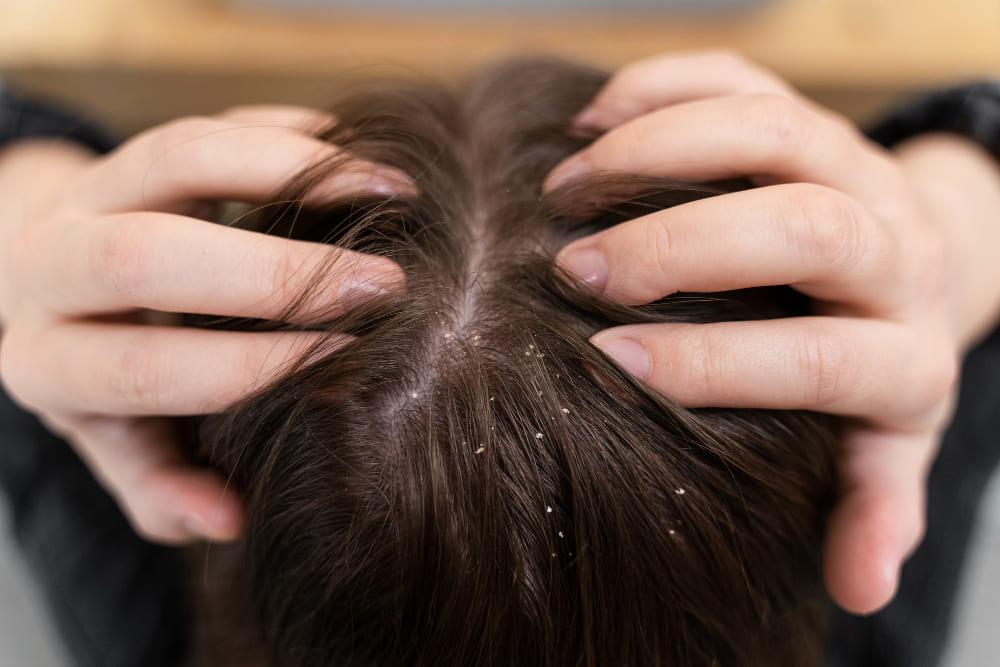

Dandruff is a common scalp condition causing flaking skin, which can be managed effectively with the right treatments, from specialized shampoos to lifestyle adjustments.
While there is no permanent “cure”, consistent care can control symptoms and restore scalp health. It’s a condition that isn’t contagious or harmful, but its visibility can be a source of social embarrassment and frustration.
Affecting approximately 50% of the adult population worldwide, dandruff is far more than just a minor annoyance. For many, it’s a chronic issue that impacts self-esteem and quality of life.
This comprehensive guide, grounded in dermatological science, will walk you through everything you need to know.
You will learn the root causes, how to differentiate it from a simple dry scalp, and explore the most effective over-the-counter and prescription treatments. Read on to reclaim your scalp health and say goodbye to flakes for good.
In This Article
Key Takeaways
- Dandruff is a mild form of seborrheic dermatitis, primarily caused by an overgrowth of the fungus Malassezia on the scalp.
- It is not caused by poor hygiene, but infrequent washing can make it more noticeable.
- Effective treatment involves using medicated shampoos with active ingredients like ketoconazole, selenium sulfide, or zinc pyrithione.
- It’s crucial to rotate shampoos and leave them on the scalp for at least 5 minutes to be effective.
- If over-the-counter treatments fail after a month, or if symptoms are severe, consult a dermatologist for prescription-strength options.
What Is Dandruff, Exactly? A Deeper Look
Before you can effectively treat it, it’s essential to understand what dandruff truly is. It’s more than just dry skin, it’s a specific medical condition with identifiable causes and characteristics.
Defining Dandruff and Seborrheic Dermatitis
Dandruff is widely considered a mild, non-inflammatory form of a broader skin condition called seborrheic dermatitis.
According to a comprehensive review in the Journal of Clinical and Investigative Dermatology, dandruff and seborrheic dermatitis exist on a continuous spectrum.
- Dandruff (Pityriasis Capitis): This is the condition when it’s restricted to the scalp. It involves itchy, flaking skin without significant, visible inflammation or redness. The flakes are typically small, white, and dry.
- Seborrheic Dermatitis: This is the more severe form. It can affect the scalp and other oily areas of the body, such as the face (especially around the nose), eyebrows, ears, chest, and groin. It presents with flaking or scaling skin, but also includes visible inflammation, redness (erythema), and often more intense itching. The scales can be yellowish and greasy.
In essence, if you have flakes without much redness, you likely have dandruff. If you have flakes with noticeable redness and inflammation, it’s likely seborrheic dermatitis.
For treatment purposes, the approach is often similar, starting with the mildest effective options.
Is Dandruff Contagious or Harmful?
This is a common concern, but the answer is a clear no. According to both the Mayo Clinic and the UK’s National Health Service (NHS), dandruff is not contagious.
You cannot catch it from someone else or pass it on by sharing combs, hats, or pillows. It is also not considered a harmful or serious medical condition in itself. However, its psychological and social impact can be significant.
The Global Impact of Dandruff
The prevalence of dandruff underscores its significance. It is estimated to affect about half of the post-pubertal population worldwide. While not physically dangerous, the burden of dandruff is real.
A 2025 study published in Psychological Reports found that individuals with more severe dandruff reported poorer mental health, lower quality of life, and increased appearance anxiety.
The visible nature of the flakes can lead to feelings of embarrassment, low self-esteem, and social stigma, making effective management crucial for overall well-being.
What Are the Main Symptoms of Dandruff?
Recognizing your symptoms is the first step toward finding the right treatment. While flaking is the most famous sign, other symptoms often accompany it.
The Telltale Flakes
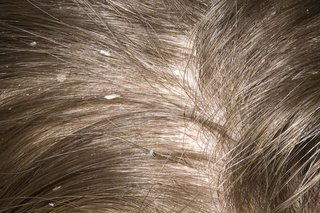
The most prominent symptom is the presence of skin flakes. These can vary in appearance:
- Location: Found on the scalp, in the hair, and often noticeable on the eyebrows, beard, mustache, and shoulders.
- Color: The flakes can be white, off-white, or yellowish.
- Texture: They may feel oily or dry.
Flakes are often more visible in people with dark hair and can become more apparent when they fall onto dark-colored clothing.
Itching and Irritation
An itchy scalp (pruritus) is another hallmark symptom of dandruff. The itch can range from mild to intense.
Scratching can worsen inflammation, damage the scalp, and lead to a vicious cycle of more irritation and flaking. It’s important to resist the urge to scratch aggressively.
Symptoms in Infants: Cradle Cap
In infants, seborrheic dermatitis is commonly known as “cradle cap”. It appears as a scaly, crusty, or oily rash on the scalp. It can also appear on the face, ears, and in the diaper area.
According to the StatPearls medical reference, cradle cap is usually not itchy and is a self-limiting condition that typically resolves on its own within the first year of life.
When Do Symptoms Worsen?
Many people find their dandruff symptoms fluctuate. Certain factors are known to make it worse:
- Cold, Dry Weather: Winter months are a common time for dandruff flare-ups. The combination of dry indoor heating and cold outdoor air can exacerbate scalp dryness and flaking.
- Stress: Emotional or psychological stress can trigger or worsen dandruff. While stress doesn’t directly cause dandruff, it can compromise your immune system, making you more susceptible to the factors that do, like the Malassezia fungus.
What Causes Dandruff? Unpacking the Root Factors
Dandruff is not caused by poor hygiene, a common misconception. While infrequent hair washing can allow flakes and oil to build up and become more obvious, it’s not the underlying cause.
The true culprits are a combination of microbiological, genetic, and environmental factors.
The Role of Malassezia globosa
The primary driver behind most cases of dandruff is a microscopic, yeast-like fungus called Malassezia globosa. This fungus is a normal resident on the scalps of most adults, where it feeds on the natural oils (sebum) produced by hair follicles.
The problem arises when this fungus grows out of control. As it metabolizes scalp oils, it produces oleic acid as a byproduct. In susceptible individuals, oleic acid irritates the scalp, triggering an inflammatory response.
This causes the skin cells to shed much faster than their normal cycle. Instead of shedding one by one invisibly, they clump together with oil, forming the visible flakes we call dandruff.
Oily, Irritated Skin (Seborrheic Dermatitis)
As mentioned, dandruff is a mild form of seborrheic dermatitis. This condition is characterized by irritated, oily skin.
People with naturally oilier scalps provide a richer food source for Malassezia, making them more prone to developing dandruff.
The Scalp Microbiome: A Delicate Balance
Emerging research highlights the importance of the scalp’s microbiome—the community of microorganisms living on our skin.
A healthy scalp maintains a balanced ecosystem. Studies, such as one published in Frontiers in Cellular and Infection Microbiology, have shown that a dandruff-affected scalp has an imbalance (dysbiosis).
Specifically, there’s often an increase in Staphylococcus bacteria and a decrease in Cutibacterium acnes (formerly Propionibacterium acnes), alongside the overgrowth of Malassezia.
This dysbiosis contributes to the inflammation and flaking characteristic of dandruff.
Sensitivity to Hair Care Products
Sometimes, the cause isn’t the scalp’s natural state but its reaction to external products. This is known as contact dermatitis.
Certain ingredients in shampoos, styling gels, or hair sprays can irritate the scalp, leading to redness, itching, and flaking that mimics dandruff. If your dandruff started shortly after switching to a new product, this could be the cause.
Who Is at Risk for Developing Dandruff?
While almost anyone can get dandruff, certain factors can make you more susceptible.
- Age: Dandruff typically begins in young adulthood (around puberty, when oil glands become more active) and continues through middle age. It can become less prevalent after age 50, though for some, it can be a lifelong condition.
- Sex: Dandruff is more common in males than females. This is thought to be related to male hormones (androgens), which can influence sebum production.
- Certain Medical Conditions: A compromised immune system or neurological conditions can increase risk. This includes people with HIV/AIDS, organ transplant recipients, and those with neurological disorders like Parkinson’s disease. The link is not fully understood but likely relates to the body’s inability to control the Malassezia fungus.
- Ethnic Variations: A study cited in the review on Seborrheic Dermatitis and Dandruff found that prevalence can vary by ethnicity. In one study, dandruff prevalence was highest in African Americans (81–95%), followed by Caucasians (66–82%), and was lowest in Chinese participants (30–42%).
Dandruff vs. Dry Scalp: How to Tell the Difference
This is one of the most common points of confusion. Treating a dry scalp with a harsh dandruff shampoo can make it worse, and vice versa. Understanding the key differences is crucial for effective treatment.
| Feature | Dandruff (Seborrheic Dermatitis) | Dry Scalp |
|---|---|---|
| Cause | Overproduction of oil and an overgrowth of Malassezia fungus. | Lack of moisture in the skin. The scalp isn’t producing or retaining enough oil. |
| Flake Appearance | Larger, yellowish or white flakes that are often oily or greasy. | Smaller, white, dry flakes that look like powder. |
| Scalp Appearance | Scalp often looks red, inflamed, and oily. | Scalp itself may look dry, but not typically inflamed or red. |
| Other Body Areas | Can affect other oily areas like the face, chest, and back. | Dry skin is often present on other parts of the body, like arms and legs. |
| Triggers | Stress, hormonal changes, infrequent shampooing. | Cold, dry air (winter), excessive washing with harsh shampoos, dehydration. |
In short: Dandruff is an oil problem, while dry scalp is a moisture problem. If your flakes are large and your scalp is oily and red, it’s likely dandruff. If the flakes are small and powdery and your skin feels tight and dry elsewhere, it’s likely a dry scalp.
How Do You Treat Dandruff with Shampoos?
For most people, dandruff can be effectively controlled with over-the-counter (OTC) medicated shampoos. The key is to find an active ingredient that works for you.
The American Academy of Dermatology (AAD) recommends looking for shampoos containing one of the following ingredients.
Understanding Medicated Shampoo Ingredients
Different active ingredients target dandruff in different ways. If one doesn’t work, another might.
Antifungal Agents (Targeting Malassezia)
- Ketoconazole: A powerful broad-spectrum antifungal that is highly effective at reducing the Malassezia population on the scalp. It is available in 1% strength over-the-counter (e.g., Nizoral A-D) and 2% strength by prescription.
- Selenium Sulfide: This ingredient slows the turnover of skin cells and also has antifungal properties. It can be found in products like Selsun Blue. Note: It can discolor blonde, gray, or chemically treated hair, so rinse thoroughly.
- Zinc Pyrithione: This is one of the most common OTC dandruff ingredients, found in products like Head & Shoulders. It has both antifungal and antibacterial properties, helping to control the microbes on the scalp.
Keratolytic Agents (Removing Flakes)
- Salicylic Acid: This ingredient acts as a “keratolytic”, meaning it helps to soften and exfoliate the dead skin cells, making them easier to wash away. It doesn’t have strong antifungal properties, so it’s often best for removing scale buildup. It’s the active ingredient in shampoos like Neutrogena T/Sal.
Cell Turnover Modulators
- Coal Tar: This is one of the oldest treatments for dandruff and psoriasis. It works by slowing down how quickly the skin cells on your scalp grow and die. Products like Neutrogena T/Gel contain coal tar. Be aware that it can have a strong odor, may stain light-colored hair, and can make your scalp more sensitive to sunlight.
How Should You Use Dandruff Shampoo Correctly?
Simply washing your hair with a dandruff shampoo isn’t enough. To get the best results, you need to use it correctly. Dermatologist Dr. Dawn Davis of the Mayo Clinic emphasizes the importance of proper application.
“Be careful and aware how you use your shampoo. Most dandruff shampoos need to be left on the scalp for more than five minutes. Shampoo has a precipitate that once applied takes several minutes to separate itself out to allow it to remain on the skin to become active.” – Dr. Dawn Davis, Mayo Clinic
Step-by-Step Guide for Maximum Efficacy
- Read the Instructions: Always start by reading the directions on the bottle, as they can vary.
- Apply to the Scalp: Concentrate the shampoo directly on your scalp, not just your hair. Part your hair in sections to ensure full coverage.
- Lather and Massage Gently: Use your fingertips (not your nails) to gently massage the shampoo into your scalp. This helps loosen flakes and allows the active ingredients to penetrate.
- Let It Sit: This is the most crucial step. Leave the shampoo on your scalp for at least 5-10 minutes. This gives the active ingredients time to work.
- Rinse Thoroughly: Rinse your hair and scalp completely to remove all residue, which can cause irritation.
- Follow with Conditioner (If Needed): Some dandruff shampoos can be drying. Apply a regular conditioner to the ends of your hair, avoiding the scalp, to restore moisture.
Frequency and Rotation
How often you should use a dandruff shampoo depends on your hair type and the severity of your symptoms.
- For Oily or Straight Hair: You may need to start by using the dandruff shampoo daily or every other day. Once symptoms are controlled, you can reduce usage to 2-3 times a week for maintenance.
- For Coarse, Curly, or Textured Hair: These hair types are more prone to dryness. The AAD suggests using a dandruff shampoo just once a week. On other wash days, use your regular moisturizing shampoo and conditioner.
Pro Tip: Rotate Your Shampoos. Your scalp can become accustomed to a single active ingredient over time, reducing its effectiveness. Dr. Davis recommends rotating between 2-3 different dandruff shampoos with different active ingredients (e.g., one with ketoconazole, one with selenium sulfide) to prevent this and achieve better long-term control.
Are There Effective Home Remedies for Dandruff?
While medicated shampoos are the most scientifically-backed treatment, some people find relief with natural or home remedies. It’s important to note that evidence for these is often anecdotal or based on small studies.
Always perform a patch test on a small area of skin before applying anything new to your entire scalp to check for irritation.
Tea Tree Oil
Tea tree oil is well-known for its antimicrobial and anti-inflammatory properties. A study published in the Journal of the American Academy of Dermatology found that a 5% tea tree oil shampoo significantly improved dandruff severity.
Never apply pure tea tree oil directly to the scalp, as it can be very irritating. Instead, add a few drops to your regular shampoo or look for a pre-formulated tea tree oil shampoo.
Coconut Oil
Coconut oil is praised for its moisturizing properties and may help improve scalp hydration. Some small-scale studies suggest it has antimicrobial benefits.
To try it, massage a few teaspoons of coconut oil into your scalp and leave it on for about an hour before shampooing it out.
This may be more beneficial for those whose flaking is related to general scalp dryness rather than classic oily dandruff.
Other Potential Remedies
- Aloe Vera: Known for its soothing and anti-inflammatory properties, applying pure aloe vera gel to the scalp before shampooing may help reduce itching and irritation.
- Manage Stress: As stress is a known trigger, incorporating stress-management techniques like yoga, meditation, or regular exercise can have a positive impact on your scalp health.
- Dietary Considerations: While the link is not definitively proven, some experts suggest that a diet rich in zinc, B vitamins, and healthy fats may help support overall skin and scalp health.
It’s important to approach home remedies with caution. What works for one person may not work for another and could potentially cause irritation.
How Can You Prevent Dandruff From Coming Back?
Dandruff is often a chronic condition, meaning it can recur even after successful treatment. The goal is long-term management and prevention of flare-ups.
- Continue Maintenance Treatment: Once your symptoms are under control, don’t stop using your medicated shampoo entirely. Continue using it 1-2 times per week to keep the Malassezia fungus in check.
- Practice Good Scalp Hygiene: Wash your hair regularly to prevent the buildup of oil and skin cells. The right frequency depends on your scalp’s oiliness.
- Manage Stress: Find healthy outlets for stress, as it is a major trigger for flare-ups. Exercise, hobbies, and mindfulness can all help.
- Limit Harsh Styling Products: Hair sprays, gels, and mousses can build up on your scalp, contributing to oiliness and irritation. Try to use them sparingly.
- Get Some Sun (Carefully): A small amount of sun exposure can help control dandruff. However, too much sun increases your risk of skin cancer. Always wear sunscreen on your face and body.
When Should You See a Doctor?
Most cases of dandruff do not require a doctor’s visit. However, you should consult a healthcare professional or a board-certified dermatologist if:
- You’ve been using an OTC dandruff shampoo consistently for several weeks with no improvement.
- Your scalp is intensely itchy, very red, swollen, or bleeding.
- The flaking and scaling are severe and causing significant distress.
- You develop scaly, red patches on your face or other parts of your body.
A dermatologist can accurately diagnose your condition, ruling out other possibilities like psoriasis or eczema, and prescribe stronger treatments.
These may include prescription-strength shampoos (e.g., 2% ketoconazole), lotions, foams, or steroid-based topical solutions to control inflammation.
Frequently Asked Questions
1. Can dandruff cause hair loss?
Dandruff itself does not directly cause hair loss. However, severe inflammation and intense scratching of the scalp can damage hair follicles, potentially leading to temporary hair shedding. Managing the dandruff and inflammation should resolve this issue.
2. Does washing my hair every day make dandruff worse?
No, for many people with oily scalps, washing daily can help control dandruff by removing excess oil and flakes. However, if you have very dry, textured hair, daily washing might be too stripping. It’s about finding the right balance for your hair type.
3. Is dandruff hereditary?
While dandruff itself isn’t directly inherited, a predisposition to it can be. You may inherit traits like oilier skin or a certain immune response to Malassezia, which makes you more likely to develop the condition.
4. Why does my dandruff get worse in the winter?
Cold, dry air in the winter can strip moisture from your skin, including your scalp. This, combined with dry indoor heating, can exacerbate both dry scalp and dandruff, leading to more noticeable flaking and irritation.
5. Can I get rid of dandruff permanently?
Unfortunately, there is no permanent cure for dandruff. It is a chronic condition that can be managed and controlled with consistent treatment. Regular use of a maintenance shampoo is often needed to prevent symptoms from returning.
6. Do I need to see a dermatologist for dandruff?
Not usually. Most cases respond well to over-the-counter shampoos. However, if your symptoms are severe, don’t improve after a month of treatment, or if your scalp is very red or painful, you should see a dermatologist.
7. What’s the difference between dandruff and psoriasis?
Psoriasis scales are typically thicker, drier, and have a silvery sheen, with more sharply defined red plaques underneath. Dandruff scales are usually finer and more oily or waxy. Psoriasis often affects other areas like elbows and knees.
8. Why did my dandruff shampoo stop working?
Your scalp can build a tolerance to a specific active ingredient over time. Experts recommend rotating between 2-3 different dandruff shampoos with different active ingredients (e.g., ketoconazole, selenium sulfide, zinc pyrithione) to maintain effectiveness.
Conclusion
Dandruff is a common and manageable condition. While it can be persistent and frustrating, understanding its causes and the most effective treatments empowers you to take control.
The cornerstone of management is the correct and consistent use of medicated shampoos, paying close attention to the active ingredients and application technique.
Remember to be patient, as it may take a few weeks to see results, and you might need to try different products to find what works best for you.
By combining effective treatments with preventative lifestyle measures, you can keep your scalp healthy, comfortable, and flake-free.
If your dandruff persists despite your best efforts, don’t hesitate to seek professional medical advice.
A dermatologist can provide a definitive diagnosis and access to a wider range of effective prescription treatments to help you achieve long-term relief.
We hope this guide has been helpful. Share it with anyone who might benefit, and feel free to leave your questions or experiences in the comments below!
Disclaimer: This article is for informational purposes only and does not constitute medical advice. The information contained herein is not a substitute for, and should never be relied upon for, professional medical advice. Always seek the advice of your physician or other qualified health provider with any questions you may have regarding a medical condition.