

Nystatin is a trusted antifungal medication primarily used to treat and prevent fungal infections caused by Candida species, most notably oral thrush and skin infections.
It has been a cornerstone of antifungal therapy for decades due to its targeted action and excellent safety profile.
Fungal diseases are a significant health concern, associated with over 13 million outpatient visits and nearly $6 billion in costs for candidiasis alone in the United States each year, according to the Centers for Disease Control and Prevention (CDC).
Understanding how medications like nystatin work is crucial for effective treatment.
This comprehensive guide will explore every facet of nystatin. We will delve into its mechanism of action, what it’s used for, available formulations, and detailed dosage instructions.
Furthermore, we will cover its efficacy based on scientific studies, potential side effects, drug interactions, and its use in special populations like pregnant women and infants.
By the end of this article, you will have a deep, evidence-based understanding of this important medication.
In This Article
What is Nystatin and How Does It Work?
Understanding nystatin begins with its classification as an antifungal agent and its unique way of targeting fungal cells without harming human cells.
This targeted approach is the key to its effectiveness and safety.
A Trusted Polyene Antifungal
Nystatin belongs to a class of drugs called polyene macrolide antibiotics. It was first isolated in 1950 from the bacterium Streptomyces noursei.
Unlike broad-spectrum antibiotics that target bacteria, nystatin is specifically designed to combat fungi, particularly yeasts from the Candida genus.
Its primary characteristic is that it is not absorbed into the bloodstream when taken orally.
This property, known as poor systemic absorption, means it acts locally in the area where it’s applied—such as the mouth, throat, or gastrointestinal tract—which significantly minimizes the risk of systemic side effects.
As noted by NCBI’s LiverTox database, this lack of absorption is a major reason for its strong safety profile.
The Mechanism of Action: Targeting Fungal Cell Walls
The effectiveness of nystatin lies in its precise mechanism of action.
Fungal cells have a unique component in their cell membranes called ergosterol, which is similar to cholesterol in human cell membranes but structurally different.
Nystatin exploits this difference.
- Binding to Ergosterol: Nystatin has a high affinity for ergosterol. It binds to these molecules within the fungal cell membrane.
- Pore Formation: Once bound, nystatin molecules group together to form pores or channels through the membrane.
- Cell Leakage: These pores disrupt the membrane’s integrity, causing essential intracellular components, like potassium ions, to leak out of the cell.
- Fungal Cell Death: The loss of these components and the inability to maintain a stable internal environment leads to the death of the fungal cell (fungicidal effect) or inhibits its growth (fungistatic effect).
Because human cells contain cholesterol instead of ergosterol, nystatin does not bind to them, making it highly selective for fungi.
This selectivity is a hallmark of the polyene class and is why nystatin is so effective against Candida infections without causing widespread damage to the patient’s own cells.
Chemical Structure and Properties
Nystatin’s chemical formula is C47H75NO17. Its large, complex structure contains a series of conjugated double bonds, which are responsible for its antifungal activity and its characteristic yellow to light tan color.
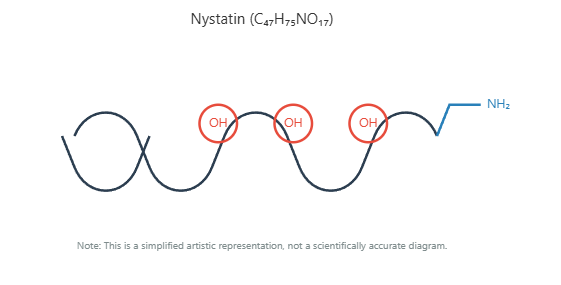
It is practically insoluble in water, which contributes to its poor absorption from the gastrointestinal tract.
This property is leveraged in its formulations, for example, the oral suspension requires shaking to ensure the drug particles are evenly distributed.
What is Nystatin Used For? Key Indications
Nystatin is approved by the FDA and other regulatory bodies for the treatment of various non-invasive Candida infections.
Because it is not absorbed systemically, it is not used for invasive or systemic fungal diseases like candidemia (Candida in the bloodstream).
Oral Candidiasis (Thrush)
This is the most common use for nystatin oral suspension.
Oral thrush is an infection of the mouth and throat characterized by white, creamy lesions on the tongue, inner cheeks, and sometimes the roof of the mouth, gums, or tonsils.
- Who’s at risk? It is common in infants, older adults who wear dentures, individuals taking certain medications (like corticosteroids or antibiotics), and those with weakened immune systems (e.g., due to HIV/AIDS or cancer treatment).
- How nystatin helps: When used as a “swish and swallow” or “swish and spit” rinse, nystatin directly coats the affected tissues, killing the Candida yeast on contact.
Cutaneous and Mucocutaneous Candidiasis
Nystatin is available as a cream, ointment, or powder to treat Candida infections on the skin. These can occur in warm, moist areas of the body.
- Diaper Rash: A common cause of severe diaper rash is a secondary Candida infection. Nystatin cream or ointment is often prescribed, sometimes in combination with a barrier cream or a mild steroid.
- Intertrigo: This is an infection in skin folds, such as under the breasts, in the groin, or in the armpits. Nystatin powder is particularly useful here as it helps keep the area dry.
Vaginal Yeast Infections (Vaginal Candidiasis)
While oral azole medications like fluconazole are often used, nystatin is also an effective treatment for vaginal yeast infections, available as vaginal tablets or suppositories.
It is considered a safe option, especially during pregnancy. Studies have shown it to be effective, particularly for infections caused by Candida albicans.
Intestinal Candidiasis
Nystatin oral tablets are used to treat fungal infections in the intestines.
Since the drug passes through the digestive tract without being absorbed, it can reduce the overgrowth of Candida in the gut.
This is sometimes used in immunocompromised patients to prevent the spread of yeast from the gut.
Prophylaxis in High-Risk Patients
Nystatin is also used prophylactically (to prevent infection) in certain high-risk groups.
- Very Low Birth Weight (VLBW) Infants: A meta-analysis published in Cureus found that prophylactic oral nystatin significantly reduced the rates of fungal colonization and invasive fungal infection in VLBW infants in the NICU.
- Cancer Patients: Patients undergoing chemotherapy or radiation may be prescribed nystatin to prevent oral thrush, a common complication of cancer treatment. However, evidence from a Cochrane review suggests that absorbable antifungals like fluconazole may be more effective for prophylaxis in this group.
Nystatin Forms and Dosage: A Detailed Breakdown
Nystatin is available in several formulations, each designed for a specific type of infection.
The dosage, measured in “units”, varies depending on the formulation, the patient’s age, and the severity of the infection.
Nystatin Oral Suspension (100,000 units/mL)
This liquid form is the standard treatment for oral thrush. It typically comes with a calibrated dropper for accurate measurement.
- Adults and Older Children: The usual dose is 400,000 to 600,000 units (4 to 6 mL) four times a day.
- Infants: The typical dose is 200,000 units (2 mL) four times a day, with 1 mL administered to each side of the mouth.
- Premature and Low Birth Weight Infants: Doses as low as 100,000 units (1 mL) four times a day have been used for prophylaxis.
Nystatin Oral Tablets (500,000 units)
These tablets are intended for treating intestinal candidiasis. They are swallowed whole and act locally within the gut.
- Adults: The standard dose is 500,000 to 1,000,000 units (1 to 2 tablets) three times a day.
Nystatin Pastilles (Lozenges) (200,000 units)
Pastilles are an alternative to the oral suspension for treating oral thrush in patients who can safely dissolve a lozenge in their mouth without chewing or swallowing it whole.
- Adults and Children (5 years and older): 1 to 2 pastilles dissolved slowly in the mouth four to five times a day. This method prolongs the contact time of the medication with the oral mucosa.
Topical Formulations (Cream, Ointment, Powder)
These are used for skin infections. The concentration is typically 100,000 units per gram.
- Cream/Ointment: Applied to the affected area two to three times a day until healing is complete.
- Powder: Applied to affected areas two or three times a day. It is especially useful for moist, intertriginous areas (skin folds).
| Formulation | Common Strength | Primary Use | Typical Adult Dosage |
|---|---|---|---|
| Oral Suspension | 100,000 units/mL | Oral Thrush (Oropharyngeal Candidiasis) | 4-6 mL, 4 times daily |
| Oral Tablet | 500,000 units | Intestinal Candidiasis | 1-2 tablets, 3 times daily |
| Pastille (Lozenge) | 200,000 units | Oral Thrush (alternative to suspension) | 1-2 pastilles, 4-5 times daily |
| Topical Cream/Ointment | 100,000 units/gram | Cutaneous Candidiasis (e.g., diaper rash) | Apply to area 2-3 times daily |
| Topical Powder | 100,000 units/gram | Cutaneous Candidiasis (especially in skin folds) | Apply to area 2-3 times daily |
| Vaginal Tablet | 100,000 units | Vaginal Candidiasis | 1 tablet inserted vaginally daily for 14 days |
How to Use Nystatin Correctly
Proper administration is key to maximizing nystatin’s effectiveness. The method varies significantly depending on the formulation.
Using Nystatin Oral Suspension
- Shake the Bottle Well: Nystatin does not dissolve completely, so shaking the suspension before each use is essential to ensure the medication is evenly distributed.
- Measure the Dose: Use the dropper or measuring device provided to get the correct amount.
- Administer Correctly: Place half of the dose in one side of your mouth (between the cheek and gum). Swish it around thoroughly, coating all surfaces.
- Repeat on the Other Side: Use the other half of the dose for the other side of your mouth and swish again.
- Hold in Mouth: Retain the liquid in your mouth for as long as possible (several minutes) before swallowing. This prolonged contact time is crucial for the drug to work on the oral mucosa. For infants, the suspension can be “painted” onto the inside of the cheeks and tongue with a swab.
- Avoid Food and Drink: Do not eat or drink for at least 5-10 minutes after using the suspension to allow the medication to remain in contact with the affected areas.
Using Other Formulations
- Tablets: Swallow whole with a glass of water. Do not crush or chew. They are designed to act in the intestine.
- Pastilles: Place the lozenge in your mouth and allow it to dissolve slowly and completely. Do not chew it. Move it around the mouth to coat all surfaces.
- Topicals (Cream/Ointment/Powder): Clean and dry the affected skin area before application. Apply a thin layer of the cream/ointment or a light dusting of the powder and gently rub it in.
Expert Tip: For all forms of nystatin, it is vital to complete the full course of treatment as prescribed by your healthcare provider, even if symptoms improve quickly. Stopping treatment early can lead to the infection returning. Treatment should typically continue for at least 48 hours after symptoms have resolved.
How Effective is Nystatin? A Look at the Evidence
The efficacy of nystatin has been evaluated in numerous clinical trials for over 70 years. Its effectiveness can vary depending on the type of infection, the patient population, and the drug it is being compared against.
Efficacy in Oral Candidiasis
For uncomplicated oral thrush, nystatin is considered a reliable first-line treatment.
A systematic review published in Drug Design, Development and Therapy found that nystatin pastilles were significantly more effective than a placebo for treating denture-related stomatitis.
The review also noted that pastilles or a combination of pastilles and suspension might be more effective than the suspension alone, likely due to longer contact time.
However, when compared to systemic azole antifungals like fluconazole, nystatin’s efficacy can be lower, especially in immunocompromised patients.
For example, a study in AIDS patients published in Clinical Infectious Diseases found that fluconazole achieved a clinical cure in 75% of patients, compared to only 52% in the nystatin-treated group.
Another study found fluconazole eradicated Candida from the oral flora in 60% of cases, compared to just 6% with nystatin.
This suggests that for more severe or difficult-to-treat cases, particularly in immunocompromised individuals, a systemic agent may be preferred.
Efficacy in Vaginal Candidiasis
Nystatin is an effective treatment for vaginal yeast infections. One study comparing nystatin to fluconazole found overall cure rates of 74% for nystatin and 87% for fluconazole.
Interestingly, the study highlighted a key difference:
- For infections caused by Candida albicans, nystatin was highly effective with a 93% cure rate.
- For infections caused by non-albicans species (like C. glabrata), nystatin’s cure rate dropped to 44.4%, whereas fluconazole achieved a 100% cure rate in this group.
This demonstrates that while nystatin is excellent for common yeast infections, other agents may be superior for infections caused by less common, more resistant species.
Efficacy in Cutaneous Candidiasis
For skin infections, topical nystatin is considered highly effective.
A review of therapies for cutaneous candidiasis noted that nystatin, along with other topicals like clotrimazole and miconazole, showed similar efficacy, with cure rates ranging from 73% to 100% across dozens of trials.
What Are the Side Effects of Nystatin?
One of the main advantages of nystatin is its favorable side effect profile, which is largely due to its minimal absorption into the body. Most side effects are localized and mild.
Common Side Effects
When taken orally (suspension or tablets), the most frequently reported side effects are gastrointestinal in nature, these may include:
- Nausea
- Vomiting
- Stomach pain or upset
- Diarrhea
With the oral suspension, some people may also experience mouth irritation or a change in taste.
These effects are usually temporary and may resolve as your body adjusts to the medication.
Rare but Serious Side Effects
While extremely rare, severe allergic reactions can occur.
You should seek immediate medical attention if you experience any signs of a serious allergic reaction, such as:
- Rash or hives
- Itching
- Swelling of the face, lips, tongue, or throat
- Difficulty breathing or wheezing
There have been very rare reports of Stevens-Johnson syndrome (SJS), a severe and life-threatening skin reaction, associated with nystatin.
SJS causes the skin to blister and peel. While the link is exceptionally rare, it is a critical potential side effect to be aware of for any medication.
Nystatin Drug and Food Interactions
Due to its lack of systemic absorption, nystatin has very few clinically significant drug interactions.
Drug-Drug Interactions
Unlike many other antifungal agents (especially azoles like fluconazole and ketoconazole), nystatin does not interfere with the metabolism of other drugs in the liver.
This makes it a particularly safe choice for patients taking multiple medications.
- Warfarin: There is a well-known and dangerous interaction between the antifungal miconazole (especially oral gel) and the blood thinner warfarin. In contrast, studies have shown that nystatin is unlikely to interact with warfarin, making it a much safer alternative for patients on anticoagulation therapy.
- Other Antifungals: Using nystatin concurrently with other topical antifungals is generally not recommended as it represents a duplication of therapy.
According to Drugs.com, there are no major or moderate interactions listed for nystatin, reinforcing its safety profile.
Always inform your doctor and pharmacist of all medications you are taking, including over-the-counter drugs and supplements.
Food and Drink Interactions
There are no known interactions between nystatin and specific foods or drinks, including alcohol.
However, for the oral suspension, it is best to avoid eating or drinking for a short period after administration to maximize its local effect in the mouth.
Using Nystatin in Special Populations
Nystatin’s safety profile makes it a suitable option for several groups who may be more vulnerable to medication side effects.
Pregnancy and Breastfeeding
- Pregnancy: Nystatin is often considered a first-line choice for treating candidiasis during pregnancy. It is classified as FDA Pregnancy Category C, meaning animal studies have not been conducted and there are no well-controlled studies in humans, but potential benefits may warrant its use. However, some authorities, like Australia’s TGA, classify it as Category A, indicating it has been used by a large number of pregnant women without evidence of harm. Given its negligible absorption, the risk to the fetus is considered very low.
- Breastfeeding: Nystatin is considered safe to use while breastfeeding. It is not absorbed systemically by the mother and therefore is not expected to pass into breast milk. It can even be applied topically to the nipples to treat thrush, though any excess cream should be wiped off before nursing.
Infants and Children
Nystatin oral suspension is the standard treatment for oral thrush in infants.
Its safety and ease of administration (by “painting” it inside the mouth) make it ideal for this age group.
As mentioned, it is also used prophylactically in high-risk premature infants to prevent serious fungal infections.
Immunocompromised Patients (HIV/AIDS, Cancer)
Nystatin is frequently used in these populations to treat and prevent oral thrush.
However, as evidence suggests, its efficacy may be lower compared to systemic antifungals like fluconazole, which are often preferred for moderate to severe infections or for prophylaxis in patients with very low immune function.
A systematic review focusing on HIV patients found nystatin was ranked as the safest antifungal agent but was less effective for achieving a cure compared to fluconazole and posaconazole.
Is Nystatin Resistance a Concern?
One of the most significant advantages of nystatin is the remarkably low rate of fungal resistance, even after more than 70 years of clinical use.
This is a stark contrast to the azole class of antifungals (like fluconazole), where resistance is a growing problem.
The mechanism of action of nystatin—physically disrupting the cell membrane—is thought to be harder for fungi to develop resistance to compared to enzymatic targets of other drugs.
While not impossible, acquired resistance in Candida albicans is exceptionally rare. Some non-albicans species may have intrinsically lower susceptibility, but overall, nystatin remains a reliable agent against most common Candida strains.
A 2024 study in BMC Oral Health found that all Candida isolates tested were susceptible to nystatin.
The Future of Nystatin: Research and New Developments
Despite being an older drug, there is renewed interest in nystatin.
Its broad spectrum, low resistance rate, and safety make it an attractive candidate for new formulations that could overcome its main limitation: poor solubility and absorption.
Researchers are exploring nanotechnology and new drug delivery systems to improve nystatin’s potential.
According to a review in ScienceDirect, these include:
- Liposomal Formulations: Encasing nystatin in lipid spheres (liposomes) to improve its delivery and potentially allow for intravenous use, similar to what has been done with Amphotericin B.
- Nanoparticles: Using polymeric or metallic nanoparticles to carry the drug, which could enhance its activity and reduce toxicity.
- Genetically Engineered Derivatives: Clinical trials are underway for promising nystatin-like derivatives, such as BSG005, which are designed to have better properties for systemic use.
These innovations could potentially expand nystatin’s use from a topical/local agent to a treatment for serious, systemic fungal infections, which are in desperate need of new therapeutic options.
Frequently Asked Questions (FAQ)
1. How quickly does nystatin work for oral thrush?
Symptomatic relief from oral thrush can often be felt within a few days of starting nystatin. However, it is crucial to complete the full course of treatment (typically 7-14 days) to completely eradicate the infection and prevent it from returning.
2. Can I use nystatin for a bacterial infection?
No, nystatin is an antifungal medication and is not effective against bacteria, viruses, or other types of microbes. Using it for a bacterial infection will not work and could delay proper treatment.
3. Do I swish and swallow or swish and spit nystatin suspension?
Your doctor will provide specific instructions. Often, the advice is to “swish and swallow” to treat any potential fungal growth further down the throat and esophagus. For purely oral infections, “swish and spit” may be recommended.
4. What is the difference between nystatin and fluconazole?
Nystatin is a topical/local polyene antifungal that is not absorbed into the bloodstream. Fluconazole is a systemic azole antifungal that is absorbed and works throughout the body. Fluconazole is often more effective for severe or systemic infections.
5. Is it safe to buy nystatin online without a prescription?
No. Nystatin is a prescription-only medication in the United States. You should only use nystatin under the guidance of a healthcare professional who can properly diagnose your condition and prescribe the correct formulation and dosage.
6. What should I do if I miss a dose of nystatin?
If you miss a dose, take it as soon as you remember. However, if it is almost time for your next dose, skip the missed dose and resume your regular schedule. Do not double up to make up for a missed dose.
7. Can nystatin cause a yeast infection?
No, nystatin treats yeast infections, it does not cause them. This is a common misconception related to antibiotics, which can disrupt natural flora and lead to yeast overgrowth. Nystatin specifically targets and kills yeast.
8. Does nystatin expire? How should I store it?
Yes, nystatin has an expiration date. Store it at room temperature, away from heat, moisture, and direct light. The oral suspension should be shaken well before use and may require refrigeration depending on the manufacturer’s instructions—check the label.
Conclusion
Nystatin remains a vital and widely used antifungal medication, prized for its effectiveness against local Candida infections, its outstanding safety profile, and its remarkably low rate of resistance.
For over 70 years, it has been the go-to treatment for oral thrush, certain skin infections, and a safe option for vaginal candidiasis, especially in sensitive populations like pregnant women and infants.
While systemic antifungals like fluconazole may be more effective for severe or invasive infections, nystatin’s targeted, non-absorbed action makes it an invaluable tool with minimal side effects and drug interactions.
As research continues to explore new formulations to enhance its capabilities, the future of this classic drug looks bright.
If you believe you have a fungal infection, it is essential to consult a healthcare professional for an accurate diagnosis and appropriate treatment plan.
We hope this guide has provided you with a clear and thorough understanding of nystatin.
If you found this information helpful, please consider sharing it with others who might benefit.
Disclaimer: This article is for informational purposes only and does not constitute medical advice. The information contained herein is not a substitute for, and should never be relied upon for, professional medical advice. Always seek the advice of your physician or other qualified health provider with any questions you may have regarding a medical condition.